World Center for Strategic Studies
From closed analysis to public debate

- MONTH
- YEAR

Germany’s Army Dream Hits The Manpower Wall
Germany says it wants to build Europe’s strongest conventional army. The World Politics Review analysis warns that Berlin is still nowhere near proving it can turn that promise into soldiers, units and real wartime capacity.
The problem is brutally simple. Money is rising, strategy documents are multiplying and Russia is treated as the central threat. But the Bundeswehr still cannot recruit enough people. The government has leaned on a voluntary service model, yet that approach is missing its targets and pushing Berlin towards a choice it desperately wants to avoid.
Germany can bring back some form of mandatory service – or quietly admit that its military ambitions are bigger than its political courage.
The rhetoric is massive
Chancellor Friedrich Merz has promised to turn the Bundeswehr into Europe’s strongest conventional army. His government also wants Germany to reduce Europe’s dependence on an unreliable United States and prepare for a Russian threat even without full American help.
That sounds like a historic shift.
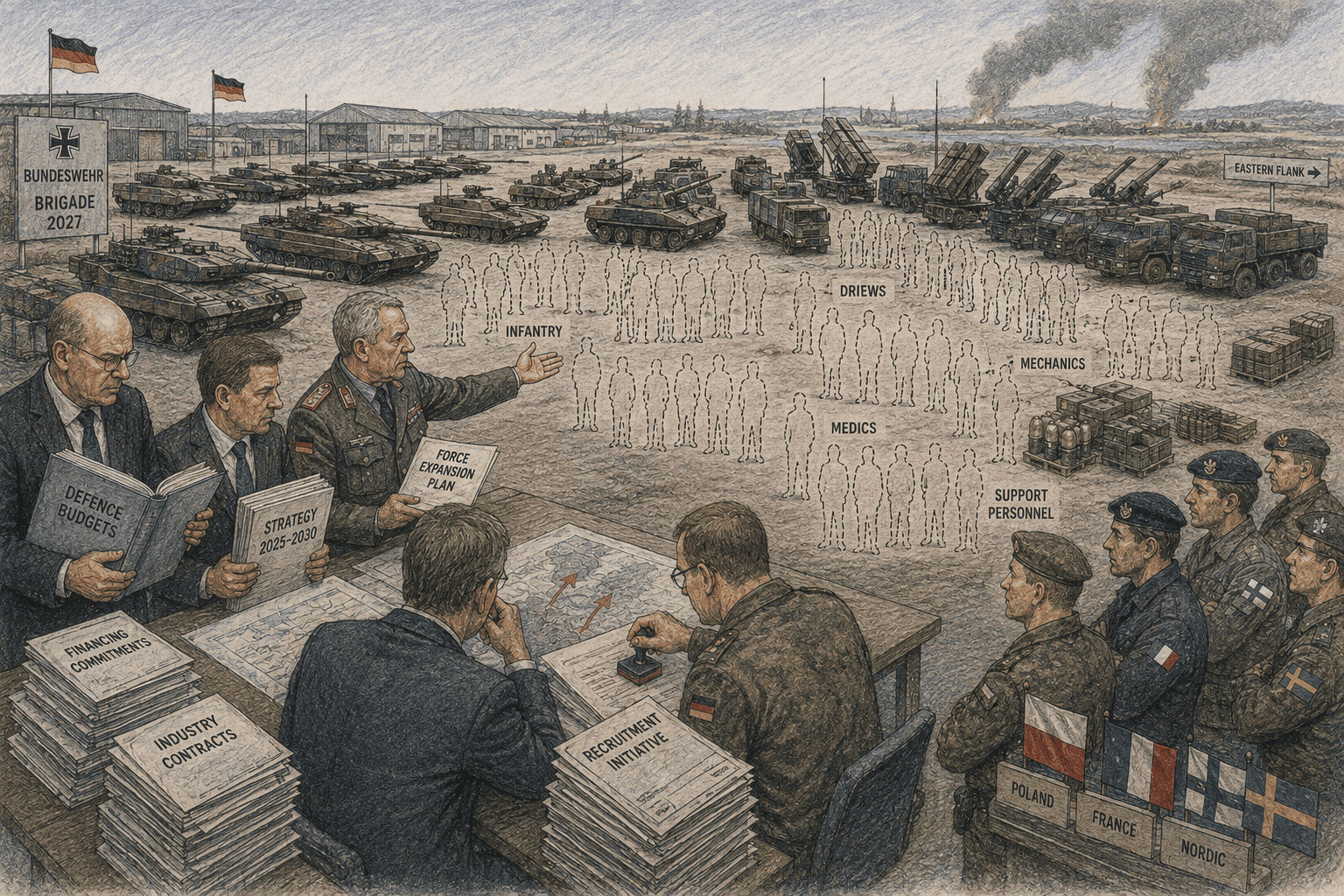
But WPR’s warning is that speeches are running far ahead of reality. A stronger army cannot be built from declarations. It needs people, training, barracks, equipment, commanders, logistics and a society willing to serve.
Berlin has found the money debate easier than the manpower debate.
The volunteer model is failing
Germany suspended conscription in 2011 and has since relied on professional and voluntary recruitment.
That model now looks too weak for the scale of Berlin’s plans. Recruitment targets are not being met, and the country’s new military service framework has so far stopped short of full compulsory service.
Instead, Germany has chosen a halfway house: young men face declarations of willingness and medical assessments, while politicians watch whether voluntary uptake improves.
That is not a mobilisation model. It is a political holding pattern.
Conscription is the ugly option
Mandatory service is the obvious fallback – but also the option most politicians fear.
Germany’s history makes military service politically sensitive. The Bundeswehr also faces practical problems: it would need training capacity, housing, instructors, equipment and a clear purpose for thousands of new recruits. Poorly implemented conscription could swamp the system rather than strengthen it.
But avoiding the decision has its own cost.
If Germany refuses compulsion while volunteers stay away, its force-expansion targets become fantasy.
NATO will judge the output
Germany’s allies are not interested in slogans about Zeitenwende anymore. They want to know whether Europe’s biggest economy can actually carry more of the continental defence burden.
That means deployable brigades, readiness, ammunition stocks, air defence, logistics and enough personnel to sustain operations.
If Berlin cannot solve the recruitment problem, its higher defence spending will not fully translate into deterrence. A richer Bundeswehr is not the same as a larger, ready Bundeswehr.
Russia will not be deterred by budget lines.
The public still looks unconvinced
The recruitment crisis also exposes a deeper social problem. Germany’s strategic debate has changed faster than German public attitudes.
Leaders now talk about war readiness, deterrence and national defence. But much of society remains uneasy about militarisation, sceptical of service obligations and distant from the armed forces.
That gap matters. A national-security shift cannot be carried by ministers alone. It needs public consent, institutional capacity and a credible story about why service is necessary.
So far, Berlin has not fully built that story.
The compromise creates confusion
Germany’s new military service law was meant to avoid the hardest fight while nudging the country towards greater readiness.
But compromise has produced uncertainty. Reporting duties, medical checks and possible future escalation to compulsion may create administrative movement without delivering enough recruits.
The danger is that Germany spends years building a soft version of service that satisfies nobody: too weak to solve manpower shortages, too intrusive to avoid political backlash.
That is a classic Berlin outcome – careful, cautious and inadequate.
The weakness rivals will exploit
The manpower problem is not a technical footnote. It sits at the centre of European security.
If Germany cannot expand its armed forces, the wider European effort to reduce reliance on the United States becomes far less credible. France and Britain have nuclear forces and expeditionary capacity, Poland is rearming fast, the Nordics are serious – but Germany’s size makes its failure uniquely damaging.
Europe needs Germany to become a military backbone.
Instead, Germany is still arguing over how to fill the ranks.
The hard lesson: Armies need people, not promises
WPR’s analysis cuts through Berlin’s defence rhetoric. Germany can announce strategies, increase budgets and promise leadership. But none of that solves the central question: who will actually serve?
The voluntary model is underperforming. Conscription is politically difficult. Giving up on targets would humiliate Berlin and worry NATO.
That leaves Germany trapped between ambition and avoidance.
Europe’s strongest army cannot be built by press conference – and Germany is about to find out.