
World Center for Strategic Studies
From closed analysis to public debate
- MONTH
- YEAR

Europe’s Digital Asia Push: Big Ambition, Weak Grip
CEPS’s in-depth analysis gives Brussels a sharp warning on digital power.
The EU wants Asian tech partners to help it survive the US-China technology squeeze.
Japan, South Korea, Singapore, India and Taiwan all matter for AI, chips, 6G, cybersecurity and digital standards.
But the study shows a weaker reality: Europe’s partnerships are too fragmented, too thinly governed and too often outpaced by national agendas.
Brussels wants a network. What it has is a patchwork.
Washington and Beijing set the pace
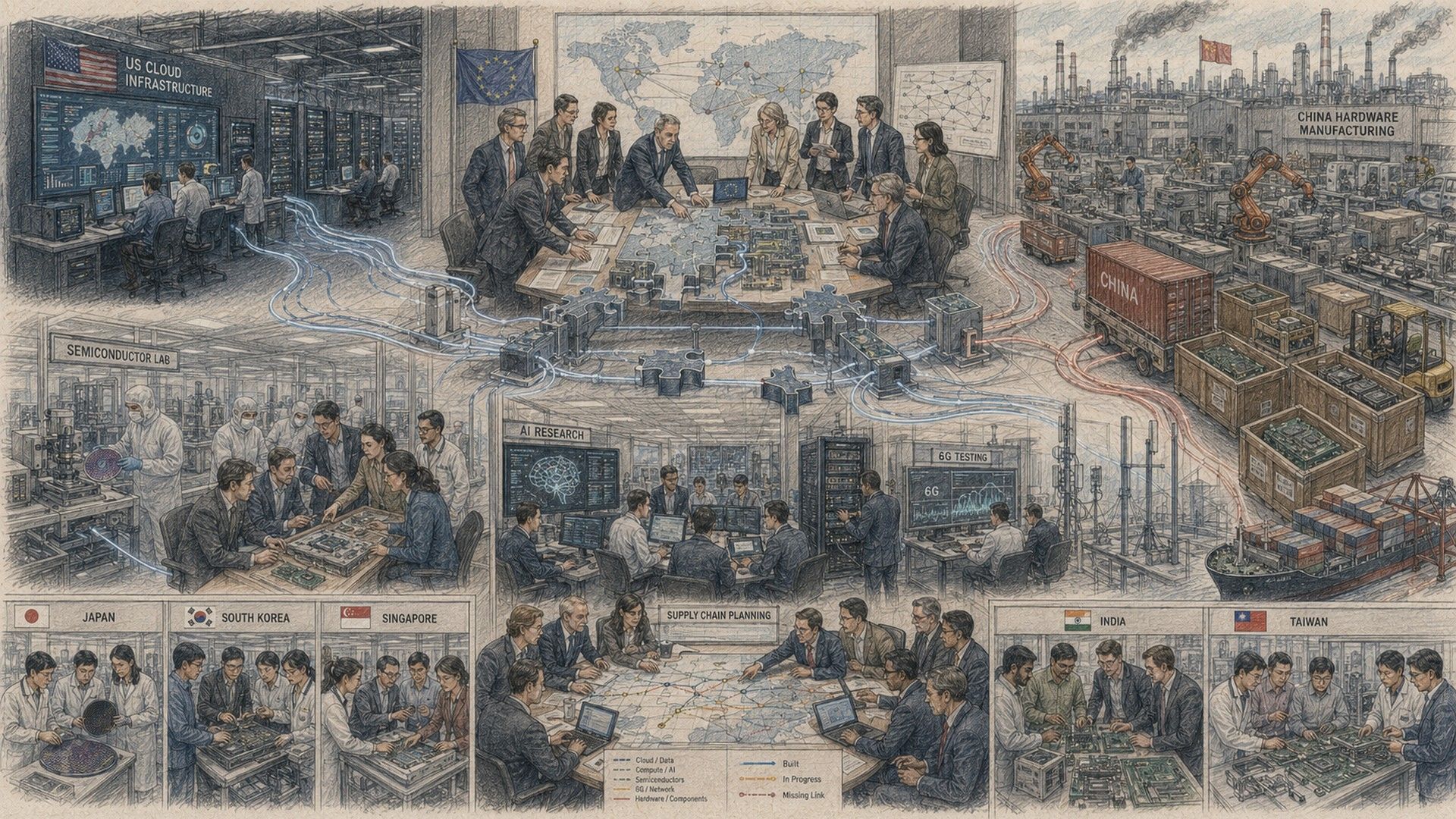
The EU is trying to build digital resilience while the two superpowers pull the tech world apart.
The US has capital, cloud power, platforms, export controls and industrial incentives. China has scale, state direction, supply-chain muscle and manufacturing dominance. Europe has rules, research strength and a desire for strategic autonomy – but not enough commercial weight.
That leaves the EU squeezed between American digital infrastructure and Chinese hardware supply chains.
Brussels is split before it starts
The paper’s most damaging point is institutional fragmentation.
EU digital partnerships are spread across the EEAS, DG CONNECT, DG Trade, DG RTD and other parts of the Brussels machine. Member states then run their own bilateral tracks, often without proper coordination.
Partner countries are fragmented too, with ministries, regulators, firms and research bodies pulling in different directions. The result is predictable: big strategy at the top, underpowered delivery underneath.
Like-minded is not aligned
Europe keeps talking about like-minded partners, but CEPS warns that values do not automatically create shared interests.
Japan, South Korea, Singapore, India and Taiwan all face their own pressures between Washington and Beijing. They do not exist to serve Europe’s autonomy agenda. They use EU ties as one option in a much bigger strategic calculation.
That is the hard reality Brussels must accept. Digital partnerships give Europe access and influence, but not control.
Korea leads – but pressure bites
South Korea has the most complete formal relationship with the EU: Horizon Europe association, a digital trade agreement, GDPR adequacy and an active Digital Partnership Council.
That makes it the strongest test case for what deeper cooperation can deliver. But it also faces the sharpest triangulation between US commercial interests and EU regulatory norms.
Europe may have a structure with Seoul, but Washington still has massive pull.
Japan is embedded but cautious
Japan already has deep industrial links with Europe, especially through automotive supply chains and production facilities.
That gives Brussels something real to build on in advanced manufacturing, cybersecurity, quantum and trusted supply chains. Yet Japan’s Horizon Europe participation has been modest so far, despite new association momentum.
The relationship has depth, but not enough digital acceleration.
Taiwan is vital but boxed in
Taiwan is the most sensitive case and one of the most important.
Its semiconductor role is hugely consequential for Europe, especially with TSMC’s investment in the Dresden fab. Since 2020, Taiwanese investment in the EU has reached billions of dollars.
Yet the EU’s One China policy blocks a formal Digital Partnership. Cooperation has to move through research institutes, industry links, member-state channels and informal frameworks. Europe depends on Taiwan’s chip strength, but cannot easily give the relationship the political architecture it deserves.
Trade fights slow the fix
CEPS argues that research and innovation should be the main route for long-term alignment.
Trade and investment deals bring fast friction over market access, regulation and commercial advantage. Research links are slower but less explosive. They build trust through joint projects, shared labs, talent pipelines and repeated cooperation.
That is why Horizon Europe-style tools matter. They may be less flashy than trade deals, but they are more useful for locking in future digital ties.
The network is still missing
The EU wants to move beyond bilateral hub-and-spoke partnerships towards a real network across Asia.
That means sectoral minilaterals on AI governance, 6G standards and semiconductor supply-chain transparency. It also means bringing in SMEs, start-ups, labour groups and civil society instead of relying only on national champions and high-level councils.
Without that broader base, Europe’s digital diplomacy will stay top-heavy and brittle.
What this reveals: Europe is not short of partners.
The CEPS message is sobering. Europe has options in Asia, but its machinery is too scattered to turn them into strategic leverage.
The EU cannot regulate its way into digital power, nor can it talk itself out of dependence on the US and China. It needs coordination, research depth, real networks and a more practical route for Taiwan.
The prize is digital resilience. The risk is another grand European strategy lost in process.