World Center for Strategic Studies
From closed analysis to public debate

- MONTH
- YEAR

Macron’s Political Legacy Is Under Pressure as France Confronts Its Post-Macron Future
France is approaching the end of Emmanuel Macron's presidency amid political fragmentation, strained public finances and growing uncertainty over the direction of the country after 2027. The CIDOB commentary, “Emmanuel Macron’s Tombstone”, examines the president's legacy against a backdrop of weakened parliamentary authority and increasingly difficult relations between the executive and France's competing political blocs. The central issue is not simply Macron's declining political influence, but whether the political system he helped reshape can remain stable once he leaves office.
France's political centre is under strain
Macron's political project was built around overcoming the traditional division between the centre-left and centre-right.
That realignment changed French politics, but it also weakened the established parties that had previously structured parliamentary competition.
With the presidential majority unable to rely on a stable legislative coalition, governing has become increasingly dependent on negotiation, tactical alliances and institutional procedures.
The resulting uncertainty raises questions about the durability of Macron's political model.
The presidency faces a difficult succession
Macron cannot seek a third consecutive presidential term in 2027.
The question of succession therefore hangs over the final stage of his presidency, while rival political forces compete to define what comes next.
The far right has expanded its electoral presence, the left remains divided over its strategy, and Macron's political camp faces the challenge of establishing an identity beyond its founder.
These tensions complicate efforts to create a stable governing majority.
October’s unrest becomes a defining moment
The article focuses on the demonstrations of 17–18 October 2026, which Ghilès portrays as a turning point in Macron's presidency.
According to the author, peaceful marches involving school students, teachers and trade unionists were followed by widespread looting and attacks on public buildings.
He reports that approximately 3,000 shops were ransacked and that the authorities underestimated turnout, leaving police unable to prevent disorder in several locations.
These figures and descriptions are presented as the author's account. His central criticism is that the government failed both to respond adequately to legitimate grievances and to maintain public security.
Young people feel abandoned
Ghilès places youth discontent at the centre of France's political difficulties.
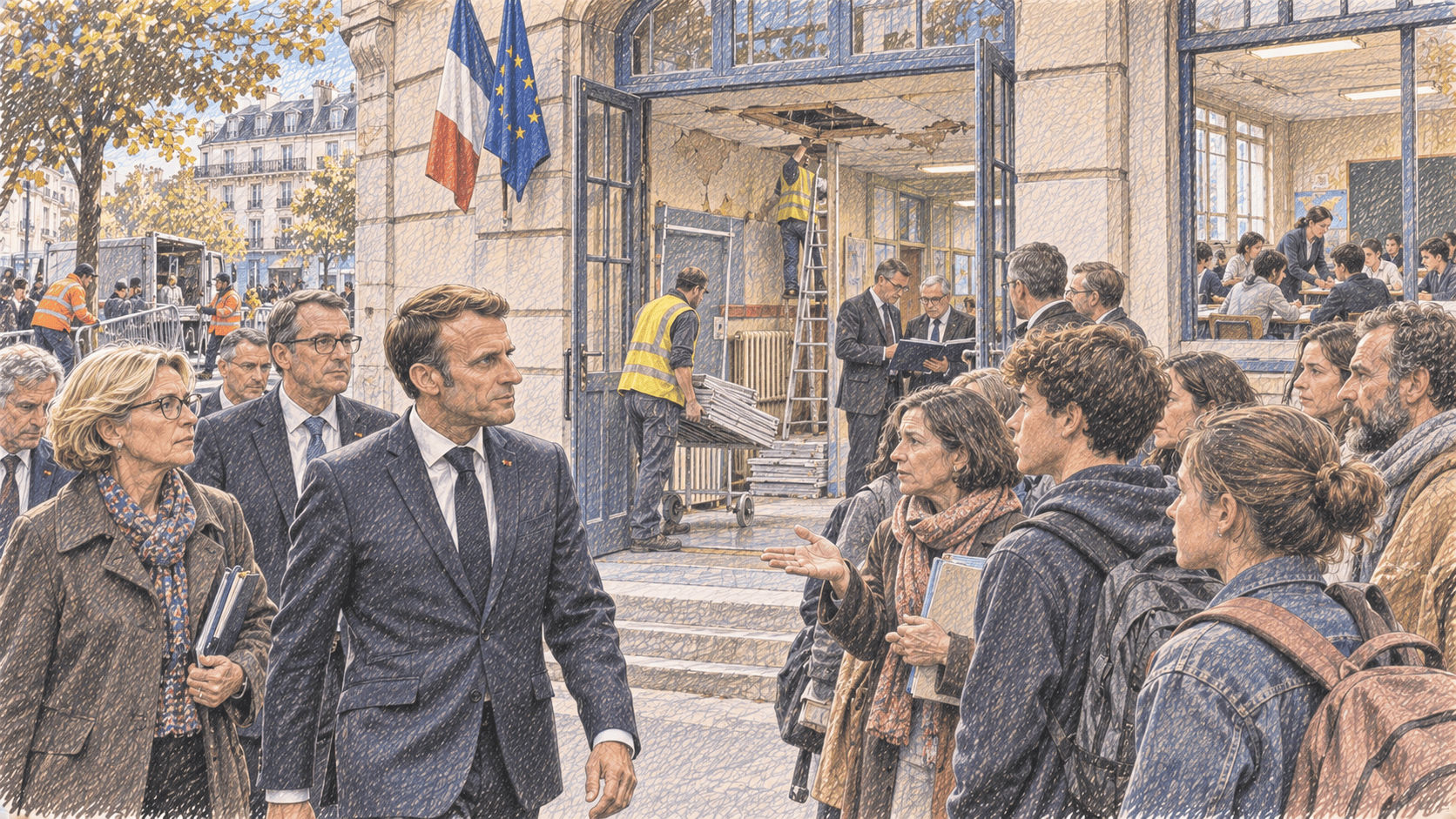
Students have protested deteriorating school buildings, teacher shortages and the perceived decline of public services.
The author also highlights a widening generational divide: younger people face economic insecurity and uncertain prospects, while older generations enjoy comparatively stronger financial protection.
In his interpretation, Macron's governing style has aggravated these grievances by creating a perception of distance between the presidency and ordinary citizens.
Police tactics deepen the crisis
The commentary criticises the authorities' handling of demonstrations before the October violence.
Ghilès alleges excessive police force against young protesters and cites injuries and thousands of preventive arrests.
He contrasts these measures with what he describes as the police's failure to prevent organised looting.
For the author, this combination raises questions about the government's ability to protect both civil liberties and public order.
France's finances leave little room for recovery
Political unrest is unfolding alongside pressure on French public finances.
Ghilès points to rising borrowing costs and concerns over the country's foreign debt.
He argues that the next president will inherit difficult economic choices regardless of the election result.
The broader concern is that weak growth, fiscal constraints and deteriorating public confidence could make social compromise increasingly difficult.
Political polarisation threatens the centre
The author argues that Macron's attempt to weaken political extremes has coincided with the strengthening of the National Rally and the influence of La France Insoumise on the left.
He criticises the increasingly confrontational language used across French politics and warns that polarisation could intensify street unrest.
His concern extends to Europe: a change in France's political direction could have consequences for EU cohesion and its ability to act internationally.
The stark truth: France's crisis extends beyond Macron's presidency
Ghilès presents the October demonstrations as evidence of accumulated social grievances, weakened political trust and an increasingly fragile relationship between the state and younger generations.
His conclusion is that France's next leadership will confront problems that cannot be resolved through electoral change alone: strained public finances, generational inequality, political fragmentation and declining confidence in established institutions.
For Europe, the significance is considerable. France remains central to the EU's economic and security ambitions, making its domestic instability a concern well beyond its borders.