World Center for Strategic Studies
From closed analysis to public debate

- MONTH
- YEAR

Europe’s Heating Transition Is Stalling: Brussels Risks Wasting Its Heat Pump Advantage
Europe has the technology and industrial capacity to reduce its dependence on gas heating, but high installation costs and inconsistent government support are holding back the transition. In a Bruegel analysis, Benjamin Bjerkan-Wade and Ben McWilliams argue that existing EU policies focus too heavily on making heat pumps cheaper to operate while neglecting the financial barriers preventing households from buying them. Their proposed solution is to impose progressively stricter efficiency standards on heating-equipment manufacturers, backed by tradable credits and penalties. The aim is to make cleaner heating more affordable, redirect installers towards heat pumps and give European factories the predictable demand they currently lack.
Europe is still burning imported gas to heat buildings
More than half of the EU's natural gas imports are used for heating buildings, while fossil-fuel heating and cooling accounted for 12% of EU greenhouse gas emissions in 2024.
Heat pumps offer a much more efficient alternative, typically producing around three units of heat for every unit of electricity consumed.
Yet their adoption remains uneven. In 2025, heat pumps accounted for approximately 28% of water-based heating-system sales in the ten EU countries examined.
The problem is not a shortage of technology, but the economics of replacing established heating systems.
Households face a costly transition
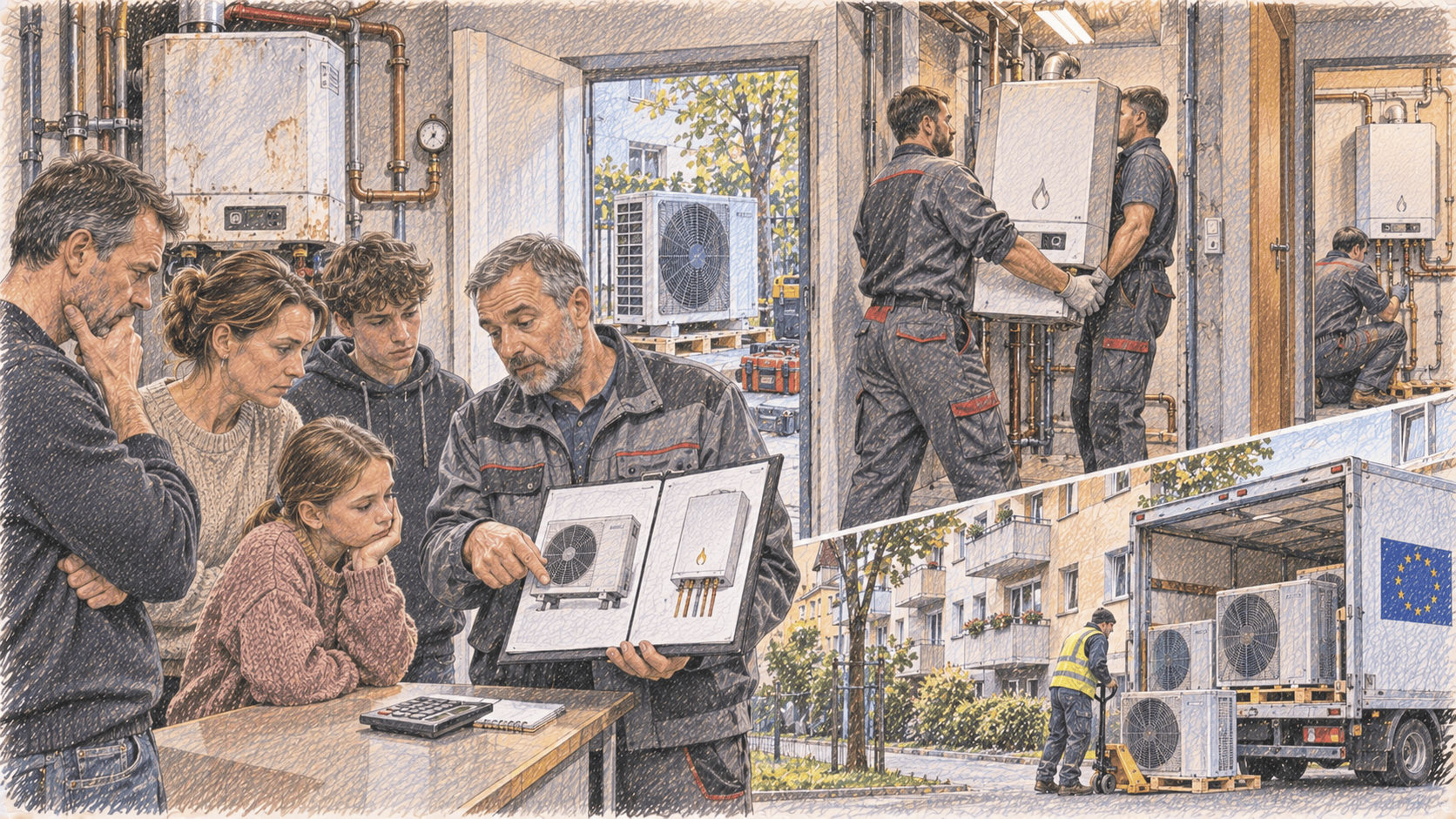
Heat pumps can cost up to five times as much as conventional gas boilers.
Although lower running costs can compensate for the initial investment, the financial benefits vary sharply between countries.
In France, where electricity is relatively inexpensive compared with gas, the additional investment can be recovered in approximately three years.
In Germany, the corresponding period is estimated at 13 years.
Bruegel argues that policies focused on electricity prices and carbon taxes cannot reliably overcome these upfront barriers.
Manufacturers could be forced to accelerate the transition
The authors propose annual efficiency requirements covering the heating appliances manufacturers sell.
Companies exceeding their targets would earn credits that could be sold to manufacturers falling behind. Those failing to comply would face financial penalties.
More efficient heat pumps would receive greater credit, while hybrid systems and smaller air-to-air units would be treated according to their actual heating contribution.
Unlike a direct ban on gas boilers, the mechanism would create financial incentives for manufacturers to increase sales of efficient heating equipment.
Britain's experience exposes the risks
The UK's Clean Heat Market Mechanism provides an early example of manufacturer obligations.
However, Bruegel warns that insufficiently ambitious targets can produce unintended consequences.
Established boiler manufacturers may discount their own heat pumps to satisfy requirements, shifting sales away from specialist producers without substantially increasing overall demand.
The authors therefore recommend sufficiently demanding targets and meaningful penalties.
Otherwise, Europe could introduce another regulatory mechanism that changes competition between companies without delivering the intended expansion of cleaner heating.
Installers remain a major obstacle
Households frequently rely on installers when choosing replacement heating systems.
Around one-quarter of EU heating systems are replaced only after breaking down, leaving little time to consider alternatives.
Traditional boiler manufacturers already influence installers through training programmes and financial incentives.
Bruegel argues that efficiency standards could redirect these commercial relationships towards heat pumps.
Manufacturers would have stronger reasons to train installers, promote efficient equipment and reward successful installations.
Europe's factories are operating below potential
The EU has annual manufacturing capacity for approximately 7.7 million heat pumps, but only two million units were sold in 2024.
This gap illustrates the industrial consequences of uncertain demand.
National subsidy programmes have encouraged adoption, but abrupt changes have also disrupted markets.
Italian air-to-water heat-pump sales fell 35% in 2024 after a generous renovation tax incentive ended. Austria experienced a 17% decline in 2025 following the withdrawal of federal replacement grants.
Predictable annual efficiency requirements could help manufacturers plan investment, expand production and reduce costs.
The reality check: Europe needs demand, not just manufacturing capacity
Bruegel's central argument is that Europe's heating transition requires a coordinated industrial and consumer policy rather than continued reliance on fluctuating subsidies and operating-cost incentives.
Manufacturer efficiency standards could make heat pumps more affordable while encouraging investment and installer training.
The European Commission is considering a clean-heat market mechanism, but its design remains undecided.
The challenge is to create sufficiently strong incentives to expand the market without imposing unnecessary costs on households. If Brussels gets the balance wrong, Europe's underused manufacturing capacity and continued dependence on imported gas could persist despite the availability of more efficient technology.