World Center for Strategic Studies
From closed analysis to public debate
- MONTH
- YEAR

Europe’s Economic Defences Are Under Siege – And Brussels Has Yet to Fight Back
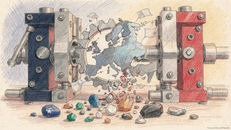
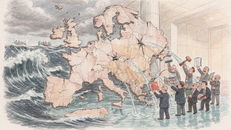
Europe is facing an unprecedented surge in economic pressure from its biggest trading partners, but its main weapon against coercion remains unused. An ISPI DataLab investigation finds that attempts to force the EU into political concessions through trade restrictions, tariffs and supply-chain controls have increased eightfold since 2018. China now accounts for 54% of the severity-weighted coercive pressure still active against Europe, followed by the United States at 20% and Russia at 17%. Yet Brussels has never activated the Anti-Coercion Instrument it adopted in 2023. The warning is clear: Europe has become dangerously exposed to economic blackmail while hesitating to use its own commercial strength.
Economic pressure has exploded
ISPI's new dataset reveals how rapidly economic coercion has become a normal instrument of international politics.
The number of coercive episodes targeting the EU has increased eightfold in eight years, accelerating particularly sharply since 2024.
The pressure is concentrated among three major powers: China, the United States and Russia.
The authors argue that economic interdependence can no longer be treated as politically neutral. Trade relationships once regarded as sources of mutual prosperity are increasingly being used to influence European decisions.
China is Europe's biggest coercive threat
Beijing accounts for 54% of the severity-weighted coercive pressure currently active against the EU.
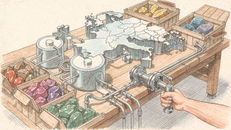
Unlike Washington, China rarely needs public ultimatums. Its leverage comes from controlling critical production and supply chains.
China possesses more than 90% of global refining capacity for rare earths and permanent magnets, giving it considerable influence over industries that depend on these materials.
In 2025, Beijing introduced export licensing requirements that sharply reduced permanent-magnet shipments and alarmed European manufacturers.
No outright embargo was necessary. Administrative restrictions alone demonstrated Europe's vulnerability.
Trump threatens more often than he acts
Washington uses a different approach.
Donald Trump's administration has repeatedly threatened European countries with tariffs and other economic penalties, treating even close allies as commercial adversaries.
But ISPI identifies an important difference between threats and implementation.
Of six new American coercion attempts recorded during 2025–2026, only one resulted in an actual coercive measure.
The other five remained threats.
Nevertheless, the authors argue that this pressure has weakened Europe's confidence that political alignment with Washington guarantees economic protection.
Russia struck fewer times – but caused enormous damage
Russia appears only three times in ISPI's dataset since 2018.
Yet Moscow's manipulation of natural-gas supplies following its invasion of Ukraine produced the most severe episode recorded.
The crisis received the maximum score of 25 out of 25 on ISPI's severity index.
By comparison, China's coercion against Lithuania scored 23, while Trump's April 2025 tariffs scored 22.
The lesson is that economic size does not determine coercive power. Control over an indispensable resource can give a smaller economy extraordinary leverage.
Brussels built a weapon and left it unused
Europe's response has been painfully slow.
The EU adopted its Anti-Coercion Instrument in November 2023 after successive confrontations involving American tariffs, Chinese restrictions against Lithuania and Russian energy pressure.
The instrument was designed to make retaliation credible when foreign governments use economic measures to influence European political decisions.
Almost three years later, it has never been activated.
ISPI presents this gap between legal capability and practical action as an increasingly serious weakness.
Germany and Italy are especially exposed
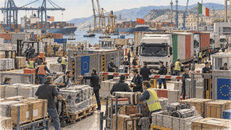
Europe's manufacturing economies face particular risks because their prosperity depends on international trade and complex supply chains.
Germany and Italy are central to this vulnerability.
But ISPI argues that their industrial strengths could also provide Europe with powerful bargaining tools.
Both countries possess specialised capabilities in electrical equipment, energy technology, pharmaceuticals, biotechnology, aerospace and defence.
These products often depend on expertise and established commercial relationships that competitors cannot easily replace.
Europe has leverage of its own
The United States and China remain major importers of sophisticated German and Italian products.
That dependence creates potential European counterpressure.
ISPI argues that these industrial strengths could underpin a more credible system of economic deterrence, making foreign governments think twice before imposing coercive measures.
The EU does not necessarily need to match every foreign restriction directly. It needs to demonstrate that economic intimidation can impose costs on the country responsible.
The uncomfortable truth: Europe has leverage but rarely uses it
ISPI's findings expose a growing imbalance between the economic pressure directed at the EU and Brussels' willingness to respond.
China exploits industrial dependencies, Washington uses tariff threats and Russia has demonstrated how energy dependence can become a strategic liability.
Europe cannot eliminate these vulnerabilities overnight. But it possesses valuable technologies, specialised industries and legal instruments capable of strengthening its position.
The danger is that Brussels continues treating economic coercion as an exceptional problem while its competitors increasingly regard it as an ordinary tool of power.