World Center for Strategic Studies
From closed analysis to public debate

- MONTH
- YEAR

Europe’s Gas Reserve Chance: Romania Has The Fuel, Ukraine Has The Vault
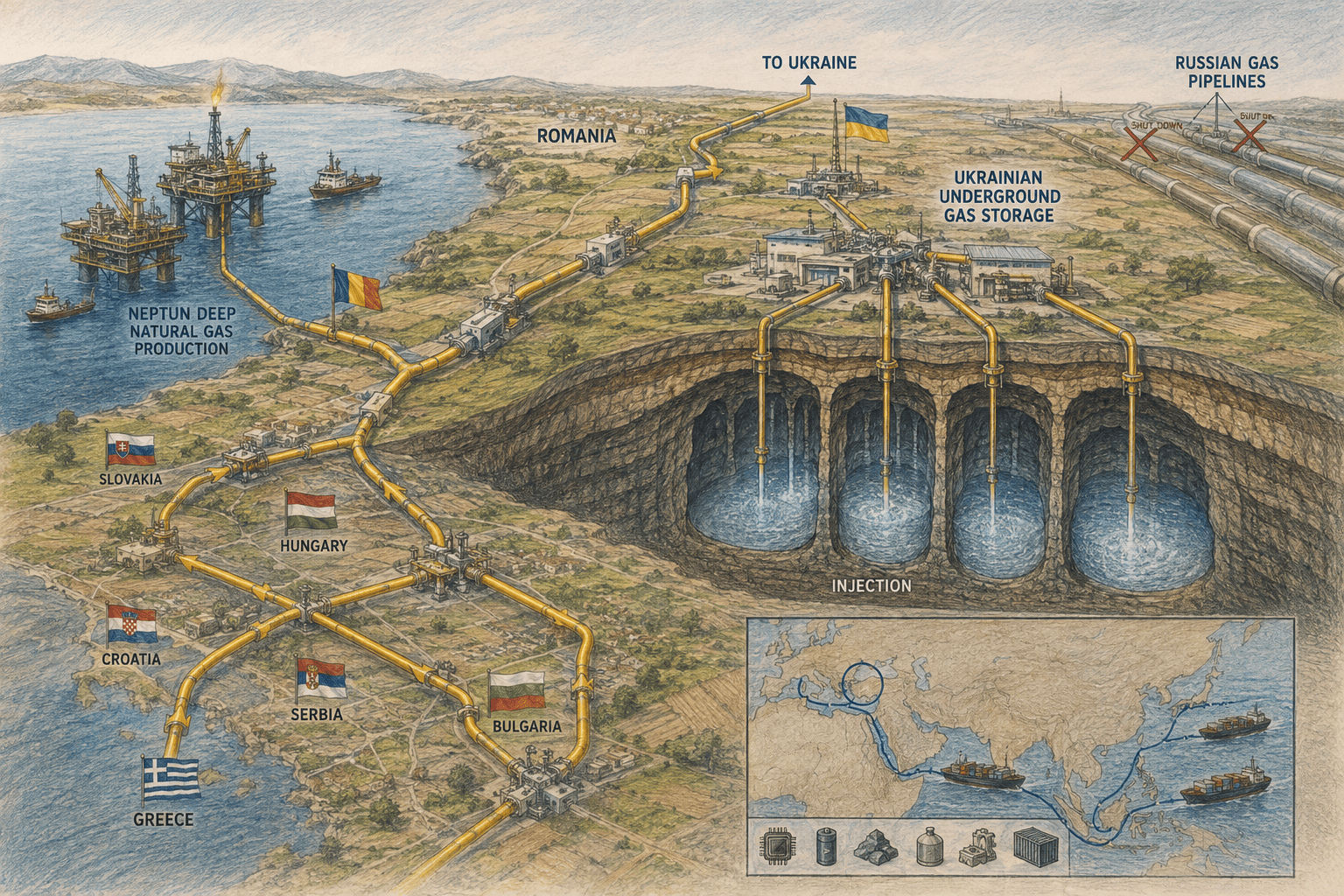
Romania is about to become one of Europe’s most important new gas players – and CEPA argues the EU should stop treating that as a narrow national windfall. With Black Sea production from the Neptun Deep project expected to start in 2027, Romania may have surplus gas at exactly the moment Europe is trying to finish its break with Russian supply.
The proposal is direct: move part of that Romanian gas north and store it in Ukraine’s vast underground storage system, turning a regional surplus into a strategic reserve for Central and South-Eastern Europe.
It sounds technical. It is not. This is about whether Europe can use its own neighbourhood intelligently – or once again let infrastructure, politics and fear waste a strategic opening.
Romania gets a rare advantage
Neptun Deep could change Romania’s place in Europe’s energy map.
Instead of being just another country worried about winter shortages and Russian pressure, Romania could become a significant regional supplier. That matters for Moldova, Ukraine, Hungary, Bulgaria and the wider Balkans – all markets that have spent years exposed to Moscow’s gas leverage.
But a surplus can quickly become a problem if it has no smart destination.
CEPA’s point is that Romania should not simply dump extra gas into the market when prices are weak. It should use the surplus as security capital.
Ukraine has the storage Europe needs
Ukraine’s gas storage system is one of the biggest in Europe. Even under war conditions, its underground caverns remain a major strategic asset.
That creates an obvious match. Romania produces. Ukraine stores. The region draws on reserves when needed.
This would give Central and South-Eastern Europe a buffer against price spikes, infrastructure shocks and Russian manipulation. It would also help integrate Ukraine more tightly into the European energy system before formal EU membership.
That is the kind of practical strategic autonomy Europe keeps promising but too rarely builds.
Russian gas is being squeezed out
The timing matters. The EU is moving towards a permanent phase-out of Russian gas imports, with LNG and pipeline bans coming through the 2027 timetable.
That leaves a gap in countries that were historically more dependent on Russian flows. Replacing Moscow’s gas is not just about signing new contracts. It requires storage, routes, interconnectors, financing and political trust.
Romanian gas stored in Ukraine would help fill the hole Russia once used as leverage.
In plain English: bury Romanian gas in Ukraine, and you bury a little more of the Kremlin’s old power.
Infrastructure is there – but underused
The regional gas map has changed since Russia’s full-scale invasion.
Old routes built to move Russian gas westwards can now be used in new directions. Romania connects to Ukraine and the wider region, while pipelines through Greece, Bulgaria, Hungary and Central Europe increasingly support reverse flows, LNG access and non-Russian supply.
But infrastructure only matters if governments unlock capacity, harmonise rules and give traders confidence that cross-border flows will work when pressure rises.
Europe’s problem is not only pipes. It is political execution.
The war risk is real
The obvious objection is security. Ukraine is under attack, and Russia has repeatedly targeted energy infrastructure.
That makes storage in Ukraine politically sensitive and commercially risky. Traders will need guarantees, insurance, access rights and confidence that gas can be injected, held and withdrawn safely.
CEPA does not pretend these problems are solved.
But the alternative is not risk-free either. Leaving Ukraine’s storage underused while Europe searches for resilience elsewhere would be another case of strategic cowardice disguised as caution.
Brussels must pay attention
This cannot be left to Romania, Ukraine and private traders alone.
A real regional reserve would require EU-level involvement: financing mechanisms, risk-sharing, market rules, emergency-access procedures and security support for Ukrainian infrastructure.
If Brussels wants Ukraine integrated into Europe’s energy future, this is exactly the kind of project it should back.
The EU has spent years talking about solidarity. A Romanian-Ukrainian gas reserve would test whether that word still means anything practical.
The weakness Europe keeps creating
The proposal exposes a familiar European failure.
The assets exist. The need is obvious. The geopolitical logic is strong. Yet Europe often lets regulatory caution, national hesitation and market uncertainty slow down projects that should be urgent.
Russia built influence by treating energy as strategy.
Europe still too often treats energy as paperwork.
The hard lesson: Energy security needs storage, not slogans
CEPA’s argument is not that gas is Europe’s long-term future. It is that during the transition, secure gas reserves still matter – especially for countries most exposed to Russian pressure and winter volatility.
Romania’s Black Sea gas and Ukraine’s storage capacity could become a powerful regional shield. They could lower dependence, strengthen Ukraine’s role and give South-Eastern Europe a buffer it badly needs.
But only if Europe moves before the next crisis.
The gas is coming. The vault is waiting.
Now Brussels has to prove it can connect the two.