World Center for Strategic Studies
From closed analysis to public debate

- MONTH
- YEAR

Europe’s Ceuta Crisis Exposes a Dangerous Blind Spot: Brussels Cannot Tell Who Is Behind Migrant Surges
Europe faces a new border-security dilemma after around 72,000 people crossed from Morocco into Spain’s Ceuta enclave in just two days. An EPC discussion paper warns that social media can accelerate mass migration movements faster than authorities can establish who is responsible. But Brussels faces an uncomfortable problem: online mobilisation does not automatically prove organised smuggling, and organised smuggling does not necessarily mean a foreign government is weaponising migration. As the EU expands its powers to confront smugglers and hybrid threats, it risks imposing punitive measures before establishing the facts. The danger is a migration-security strategy that becomes more forceful without becoming more reliable.
Ceuta exposes Europe's intelligence gap
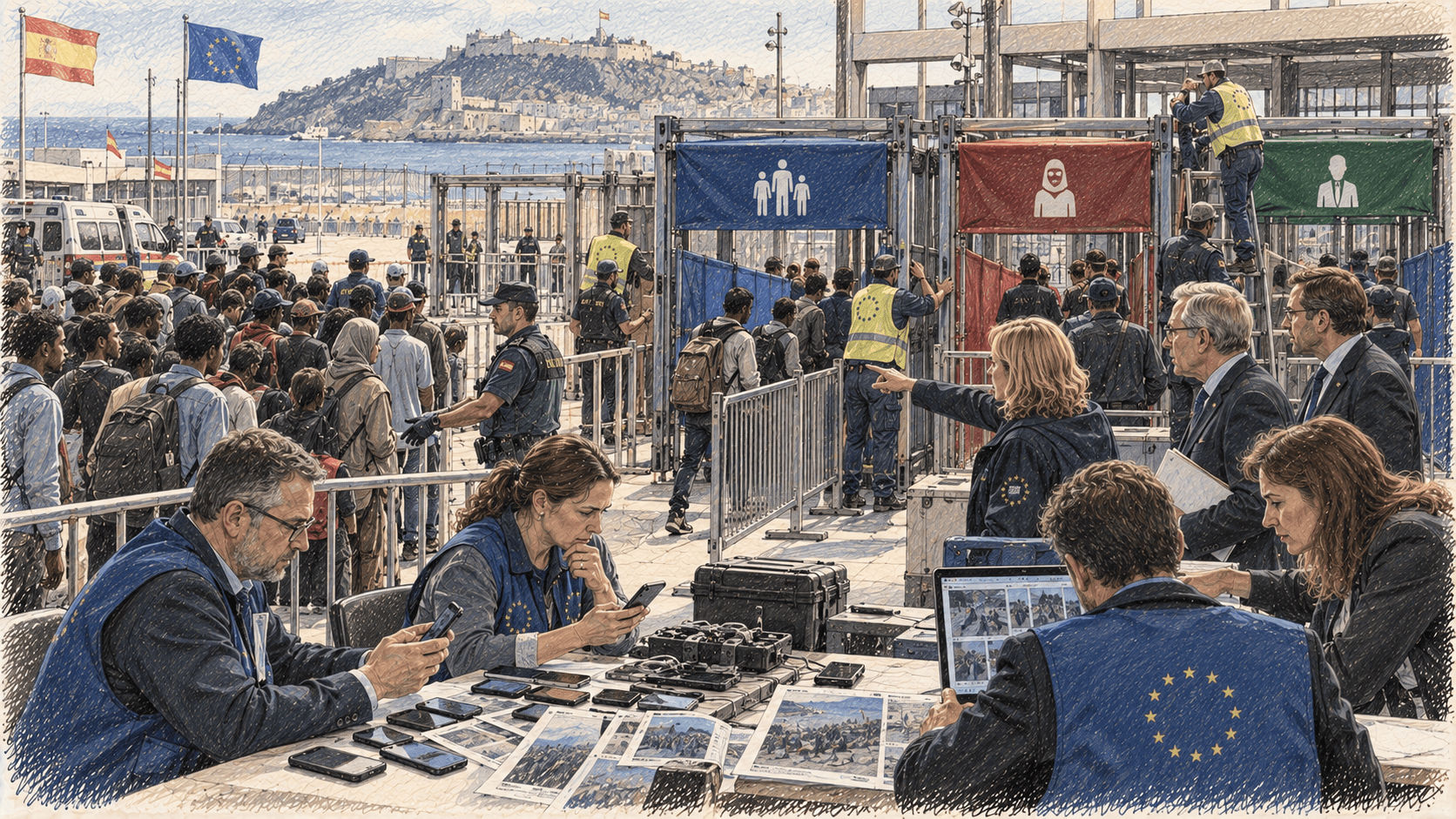
The events of 30–31 July 2026 demonstrated how quickly a border situation can escalate.
Before the crossings, messages circulated through social networks and messaging applications encouraging people to travel to Ceuta and suggesting that entry was possible.
But investigators face a fundamental uncertainty: who originated these messages, who amplified them and whether the movement was deliberately coordinated.
EPC argues that the available evidence establishes a role for digital communication, not a definitive explanation of responsibility.
Social media is not proof of a conspiracy
The same online patterns can emerge from very different activities.
Migrants may exchange information independently. Smuggling networks may advertise opportunities for profit. Organised groups may coordinate movements. State authorities might also deliberately exploit migration for political purposes.
These possibilities require different responses.
Treating every sudden increase in border crossings as evidence of hostile orchestration risks confusing ordinary communication, criminal activity and deliberate state interference.
Smuggling and weaponisation are different problems
EPC identifies a critical distinction between facilitating movement, coordinating it and intentionally using migration to pressure another country.
Evidence that someone helped migrants cross a border does not prove that they organised the wider movement.
Likewise, evidence of coordination does not automatically establish an intention to weaponise migration.
The distinction matters because the EU increasingly treats migrant smuggling and migration instrumentalisation as security threats, potentially triggering very different legal and political consequences.
Brussels is building tougher instruments
The EU is expanding its response through Europol and the European Centre Against Migrant Smuggling.
It is also developing a sanctions framework targeting smugglers and traffickers, alongside international cooperation through the Global Alliance to Counter Migrant Smuggling.
Meanwhile, its emerging approach to hybrid threats includes instruments for responding when migration is allegedly manipulated by hostile actors.
The proposed European Emergency Response Framework, announced in the 2026 State of the Union address, adds another dimension to this expanding security architecture.
But more instruments also mean more opportunities to make decisions on incomplete evidence.
Punishment demands stronger proof
The paper's central recommendation is to distinguish between measures that help establish facts and measures that impose penalties.
Authorities should be able to launch investigations, exchange intelligence and cooperate internationally before responsibility has been conclusively established.
Sanctions, however, require stronger evidence identifying responsible actors.
Measures explicitly justified by deliberate migration instrumentalisation demand an even clearer basis for establishing intent.
EPC argues that the more coercive and politically consequential an EU response becomes, the higher the evidentiary threshold should be.
Europe cannot afford to wait – or rush to judgment
Border emergencies create pressure for immediate action.
Governments cannot simply suspend their response while investigators establish every detail. Yet premature accusations can misidentify perpetrators, distort diplomatic relations and undermine the credibility of subsequent enforcement.
EPC therefore favours a graduated response: investigate rapidly, coordinate operational measures and reserve stronger penalties for cases where the evidence supports them.
The objective is not weaker border security but a more defensible system for deciding who should face which consequences.
The hard lesson: Europe needs evidence before assigning blame
The Ceuta episode exposes a weakness in the EU's emerging migration-security framework. Brussels is developing more powerful tools against smuggling and hostile interference, but its ability to establish responsibility may lag behind its willingness to act.
EPC warns against allowing uncertainty itself to become proof of wrongdoing.
Europe needs to respond quickly to border crises without treating every surge in irregular migration as a coordinated attack. Otherwise, tougher enforcement could come at the expense of accuracy, legal credibility and effective security policy.