World Center for Strategic Studies
From closed analysis to public debate
- MONTH
- YEAR

Europe’s Energy Trap: Hormuz Crisis Exposes a Costly Failure to Escape Gas
Europe is facing another energy shock, and the uncomfortable lesson is that four years of diversification have not delivered real protection. The disruption of shipping through the Strait of Hormuz and Iranian attacks on Qatar’s energy infrastructure have sent gas prices higher just as the EU prepares for winter. A Centre for European Reform analysis by Elise Viadere warns that Europe remains dangerously exposed to global fuel markets, despite reducing its reliance on Russian pipeline gas. The problem is no longer simply where Europe buys its energy – it is how deeply gas prices still control electricity bills, industrial costs and public finances.
Winter arrives with weaker reserves
EU gas storage stood at just 75 per cent on October 27, compared with 83 per cent a year earlier and 91 per cent in October 2022. Although Brussels sees no immediate supply emergency, the margin of safety has narrowed.
Filling storage to 80 per cent ahead of winter 2026-27 could add €10-15 billion to refilling costs. A prolonged conflict with Iran, another infrastructure attack or a cold winter could quickly make the situation worse.
Russia replaced, vulnerability remains
Europe has traded much of its dependence on Russian pipelines for exposure to global liquefied natural gas markets. LNG accounted for almost half of EU gas imports by the second quarter of 2026, compared with roughly 20 per cent in early 2021.
Unlike pipeline supplies, LNG cargoes can be redirected towards buyers offering higher prices. Europe now competes directly with Asian markets, while the traditional commercial incentive to store cheap summer gas for winter has weakened.
Energy security is becoming an increasingly expensive public responsibility.
Taxpayers pay for political protection
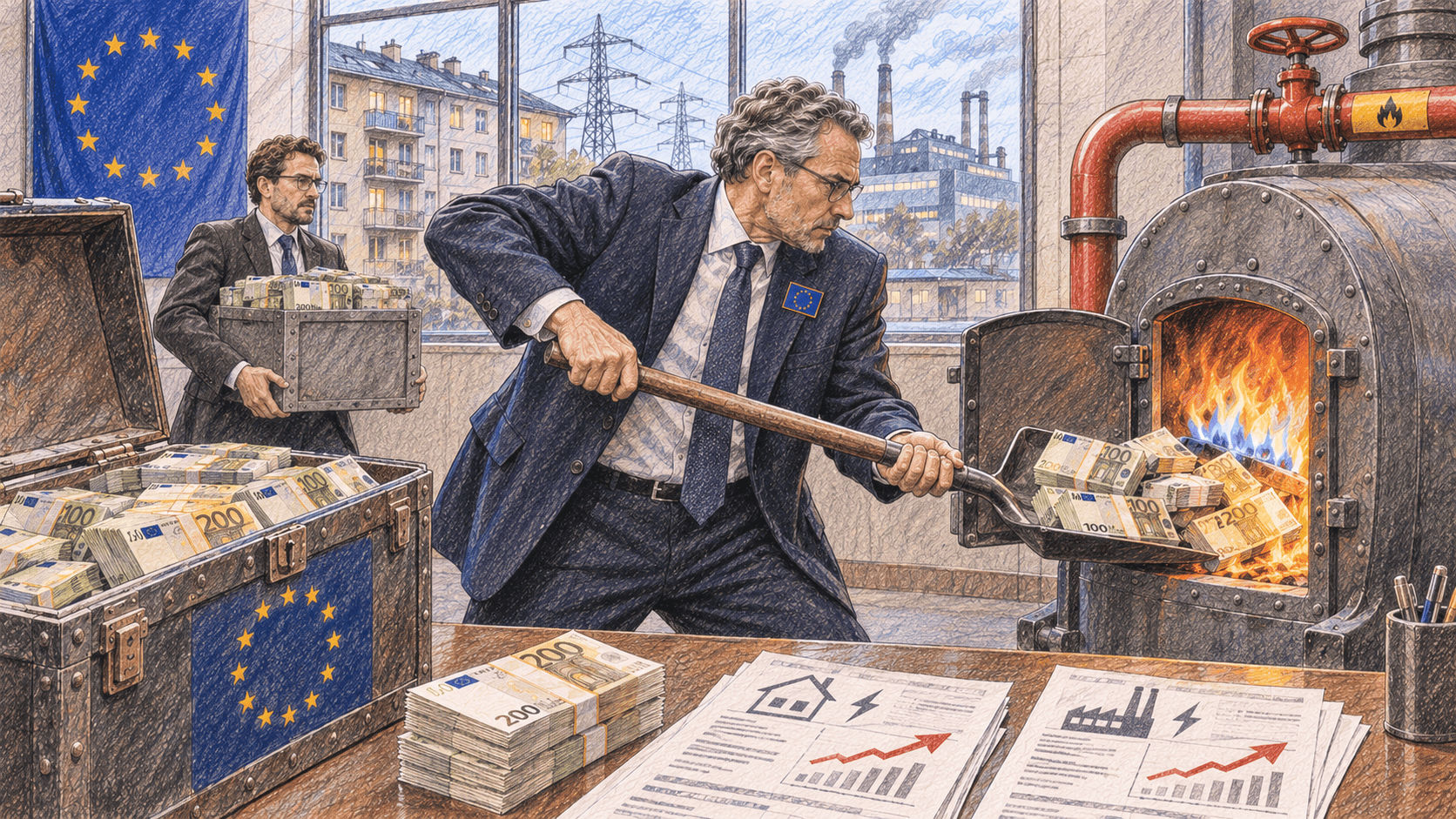
European governments are again spending heavily to cushion households and businesses from soaring energy bills.
Emergency support announced by early May was estimated at €14.5 billion for 2026. Extending those measures through December could raise the bill to €38.6 billion.
Three-quarters of the assistance is untargeted, while much of it reduces fossil-fuel prices directly. This protects consumers temporarily but weakens incentives to save energy and increases pressure on already stretched budgets.
With elections approaching in France, Italy, Poland and Spain, governments face strong political pressure to maintain expensive relief.
Gas still dictates electricity prices
Europe's electricity market contains a damaging contradiction. Gas-fired power stations can determine wholesale electricity prices even when they generate a relatively small share of total power.
In 2022, gas produced only 19 per cent of EU electricity but set wholesale prices 55 per cent of the time. Modelling suggests gas could still determine prices around half the time in 2030, even if its generation share falls to 11 per cent.
That leaves households and manufacturers paying higher electricity prices when gas becomes expensive, undermining the economic case for electrification.
Clean energy needs more than promises
The analysis argues that renewable generation alone cannot break gas's influence. Europe also needs stronger electricity grids, interconnectors, batteries and flexible demand to reduce reliance on gas-fired plants during periods of weak wind and solar output.
Australia and Spain demonstrate that better market design and storage can reduce the frequency with which gas determines electricity prices.
Brussels must also correct taxes, network charges and investment incentives that make electricity unnecessarily expensive compared with gas.
China presents the next dependency risk
Escaping imported gas will create new industrial challenges. China accounted for more than 80 per cent of global battery-cell production in 2025, leaving Europe's clean-energy expansion exposed to concentrated supply chains.
The paper calls for diversified suppliers and stronger European manufacturing in strategically important technologies, rather than an expensive attempt to produce everything domestically.
Public funding should target genuine market failures, particularly cross-border infrastructure and energy security, instead of replacing investment that private markets could deliver.
The hard lesson: Europe's gas dependence keeps draining its economic strength
The Hormuz crisis has exposed the limits of Europe's energy-security strategy. Replacing Russian supplies with LNG has improved access to alternative suppliers but failed to shield European consumers and industry from global price shocks.
Brussels must abandon broad, costly subsidies in favour of targeted protection and accelerate investment in electrification, grids, storage and flexible electricity markets. Without structural reform, the EU risks repeatedly paying billions to manage crises it has failed to make itself resilient against.
Europe cannot control global gas prices. It can reduce their power over its economy.